
Your Local Mortgage Lender
Located in Downers Grove, IL
Personalized Mortgage Experience
Mike Ruffalo offers personalized service and loan options you'll love. We shop multiple lenders to find the best rate and product for you, getting you into your dream home faster.
With wholesale interest rates and cutting-edge technology, we make the mortgage process seamless. Trust the experts who focus solely on mortgages. Support your local community and experience elite client service.
Let us help you achieve your homeownership dreams!
The Home Loan Process
Mortgage Pre-Approval
Get pre-approved from one of our Loan Officers to see how much you can afford.
House Shopping
Work with a trusted Real Estate Agent to find a home you would like to move into.
Loan Application
Complete your home loan application to get the lending process started.
Don't take my word for it
Mortgage Programs
Experience the best mortgage experience located in Downers Grove, IL
Home Loan Options
Our experienced mortgage advisors will walk you through the best mortgage loan program that will fit your specific scenario.
Conventional Home Loans.
FHA Home Loans.
USDA Home Loans.
VA Home Loans.
Frequently Asked Questions
How often can I refinance my mortgage?
There is no limit to the number of times you can refinance. However, you must qualify every time you apply and there will be costs associated with closing the loan each time.
Can I buy a home if I do not have money for a down payment?
Yes! There are a number of bond programs that offer low or no down payment financing options.
How do I know which mortgage is right for me?
The key to choosing the right mortgage is to understand the range of options and features available to you, as well as your budget, circumstances, and goals. Our licensed mortgage professionals are here to help you navigate that process. The more you know, the more comfortable and confident you will be choosing the best option for you and your family.
How long will the loan process take?
The Truth in Lending Act (TILA) does not permit a lender to close a loan until at least seven (7) business days have passed from the date your application was received. A typical home loan takes 30 days, as a number of third-party services such as appraisals, title work, and credit are required in conjunction with the mortgage process. Once you familiarize your Loan Officer with the details of your specific loan scenario, they will be able to provide you with a more specific timeline.
Will I qualify for a home loan?
The only way to find out is to speak with a qualified mortgage professional. Our Loan Officers have helped numerous clients who didn’t know if they could qualify to become home owners. We take the time to understand your financial situation and long-term financial goals, and then match you with the loan program that best fits your needs. Your approval for a loan may also largely depend on the price of the home you are financing. Getting pre-qualified prior to beginning your home search can give you an idea of what you may be able to afford.
Why do people refinance their mortgages?
Homeowners typically refinance to save money, either by obtaining a lower interest rate or by reducing the term of their loan. Refinancing is also a way to convert an adjustable loan to a fixed loan or to consolidate debts.
How much money will I have to pay upfront to buy a home?
This question does not have a simple, one-size-fits-all answer. The exact amount will depend on the price of the home you buy as well the type of mortgage financing you choose. Depending on your loan program, your down payment could be as much as 20% of the home’s price or as little as 3%, while some loans require no down payment at all.
Can I get a mortgage after bankruptcy?
You may still qualify for a home loan even if you have experienced a bankruptcy. The best way to find out if you qualify is to talk with a Loan Officer to discuss your options. Be sure to bring all paperwork regarding your bankruptcy so your Loan Officer can find the program that best fits your situation.
Should I lock my interest rate now, or wait until we are closer to our closing?
Interest rates fluctuate all day, every day. If an interest rate is good, it may be in your best interest to lock now. If you wait, you run the risk of an increase in rates later. If you are concerned that rates may go down after you lock, contact your Loan Officer to discuss your options. Some programs allow you to lock for an extended period and choose to lower your rate should a better one become available.
Most Recent Blog Updates
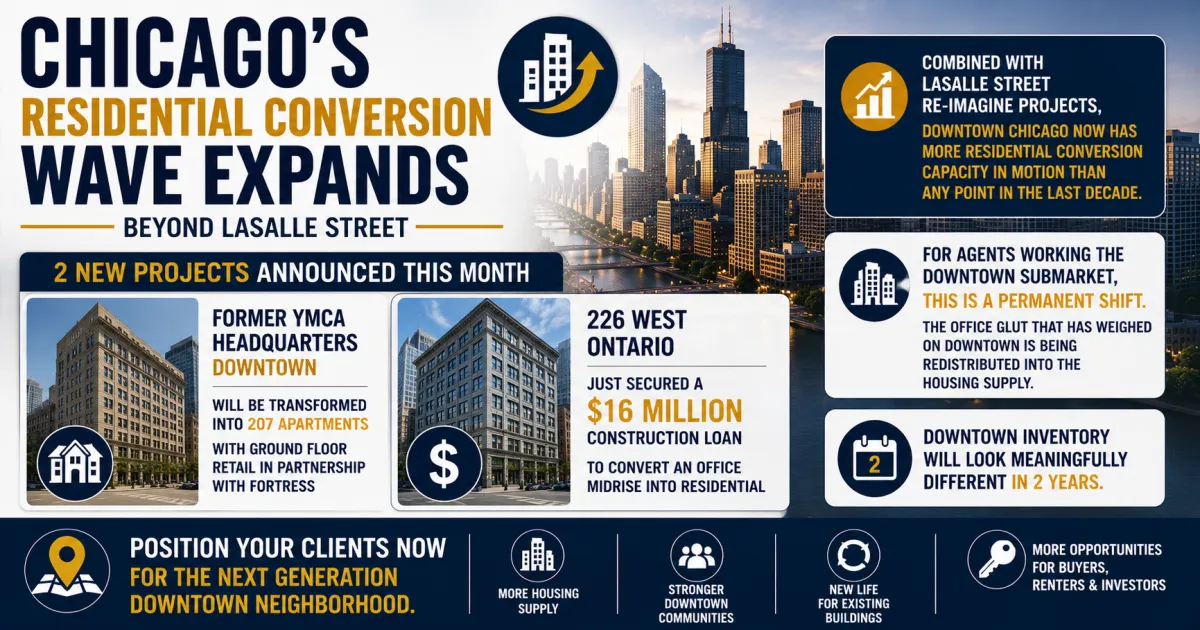
Chicago Office to Residential Conversions Are Expanding Fast and Here Is What It Means for Buyers Now
w
The Downtown Chicago Transformation That Is Moving Faster Than Most People Realize
The office-to-residential conversion wave in downtown Chicago has expanded well beyond the Lasalle Street corridor where it started and two new projects announced this month make clear that this is not a trend. It is a permanent structural shift in how downtown inventory is being created and what the neighborhood will look like in two to three years.
The Two New Projects Worth Knowing About
The former YMCA headquarters downtown is being transformed into 207 apartments with ground-floor retail in partnership with Fortress. This is a significant addition to the conversion pipeline and the retail component signals confidence in the street-level activation that residential density produces.
226 West Ontario just secured a sixteen million dollar construction loan to convert an office midrise into residential units. The financing milestone means this project is moving from announcement to execution and the units it produces will be entering a market that is already changing faster than most observers anticipated.
Combined with the Lasalle Street Reimagine projects already in motion downtown Chicago now has more residential conversion capacity underway than at any point in the last decade. The office glut that has weighed on downtown values and vacancy metrics for years is being actively redistributed into housing supply rather than sitting as permanent drag on the submarket.
What This Means for the Downtown Submarket
As Mike Ruffalo explains for agents and buyers working the downtown submarket this is a permanent shift that requires repositioning now rather than after the inventory arrives.
The character of downtown Chicago neighborhoods is changing. The office buildings that defined blocks for decades are becoming residential buildings. Ground-floor retail follows residential density. Walkability improves. The demographic profile of residents changes as more people choose to live downtown rather than simply work there. All of those shifts affect what properties are worth, which blocks become desirable, and where the next appreciation curve is being established.
Downtown inventory will look meaningfully different in two years. The buyers who understand what is being built now and position themselves in the right locations before the conversions are complete are capturing the value of that transformation at the front end rather than paying the premium that follows once the neighborhood is already different.
How to Position Clients Right Now
The practical application for agents and buyers is straightforward. Know which blocks are in the conversion pipeline. Understand which projects are financed and moving versus which are still in the announcement stage. Identify the locations where residential density is being added and where ground-floor retail activation is following.
Buyers who want to live downtown and who are evaluating options now have an opportunity to make decisions with knowledge of what the neighborhood is becoming rather than only what it currently is. That forward-looking positioning is exactly the kind of value a market-informed advisor provides.
Mike Ruffalo tracks the Chicago downtown submarket closely and works with buyers and agents to understand where the market is heading rather than only where it has been. Reach out to Mike Ruffalo to have that conversation about what the conversion wave means for a specific downtown purchase decision right now.
Sources
ChicagoAssociationofRealtors.com
Crain'sChicagoBusiness.com
MortgageNewsDaily.com
CoStar.com
Investopedia.com

Mortgage Calculator
See your total mortgage payments using the tool below.
| Year | Interest | Principal | Balance |
|---|